





Nothing built its reputation on design — transparent backs, light strips, and clean software — but the hardware underneath has quietly become just as interesting. Across the Phone (3), Phone (4a), and CMF Phone 2 Pro, Nothing mixes Qualcomm Snapdragon chips, 50MP-led cameras, and bright AMOLED displays at very different prices. Here is how the hardware actually stacks up.
CPU and GPU: Snapdragon across the range
The flagship Phone (3) runs Qualcomm’s Snapdragon 8s Gen 4, an octa-core chip clocked up to 3.21GHz with an Adreno 825 GPU. It sits a step below Qualcomm’s top Elite chips, which is a deliberate trade: near-flagship speed for everyday apps and games, without flagship pricing. The Phone (4a) steps down to the Snapdragon 7s Gen 4 with an Adreno 810 GPU, a solid upper-midrange combination for smooth scrolling and moderate gaming. The CMF Phone 2 Pro switches to MediaTek’s Dimensity 7300 Pro with a Mali-G615 MC2 GPU, a power-efficient 4nm chip that handles daily tasks comfortably and keeps the price low. All three run Nothing OS on Android, with the Phone (3) on Android 16 and Nothing OS 4.
Camera hardware: 50MP everywhere, zoom at the top
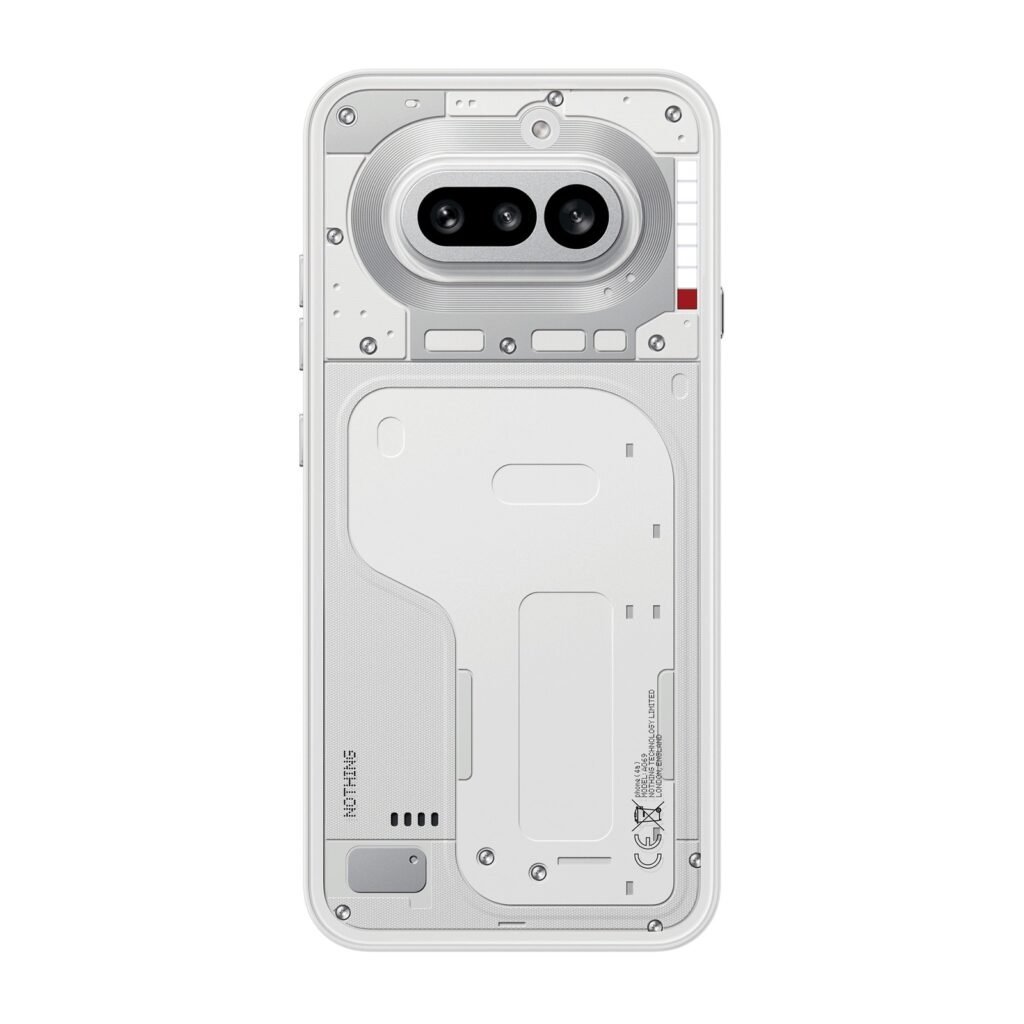
Nothing’s camera story is consistency: every model here leads with a 50MP main camera with optical image stabilization. The Phone (3) goes furthest, adding a 50MP periscope telephoto camera with 3x optical zoom and a 50MP ultra-wide camera, plus a 50MP front camera, and records 4K video at 60 frames per second. The Phone (4a) is close behind with its own 50MP main, 50MP periscope telephoto at 3.5x optical zoom, and ultra-wide camera, plus a 32MP front camera. The CMF Phone 2 Pro keeps the 50MP main camera but pairs it with a 50MP 2x telephoto and an 8MP ultra-wide, plus a 16MP front camera. The pattern is clear: Nothing spends its camera budget on the main sensor and stabilization first, then adds real optical zoom as you move up the range, rather than padding the spec sheet with low-resolution filler lenses.
Display: bright AMOLED panels at every tier
Displays are another Nothing strength. The Phone (3) uses a 6.67-inch flexible AMOLED panel at 120Hz with a peak brightness of 4,500 nits, protected by Gorilla Glass 7i. The Phone (4a) goes slightly larger at 6.78 inches with the same 120Hz refresh rate and 4,500-nit peak. The CMF Phone 2 Pro uses a 6.77-inch AMOLED display at 120Hz with a 3,000-nit peak and Panda Glass protection. In practice, all three should look sharp and stay readable outdoors; the flagship pair simply pushes brightness further for harsh sunlight and HDR video.
Current flagships
The Phone (3) is Nothing’s current flagship, with a 5,150mAh battery, 65W wired charging, 15W wireless charging, and IP68 dust and water resistance. The Phone (4a) is the newer midrange option with a 5,080mAh battery and 50W wired charging. The CMF Phone 2 Pro remains the value pick, with a 5,000mAh battery, 33W charging, and a microSD slot — the only one of the three that lets you expand storage. See full specifications on the Phone (3), Phone (4a), and CMF Phone 2 Pro pages.
FAQ
What chip does the Nothing Phone (3) use?
It uses Qualcomm’s Snapdragon 8s Gen 4 with an Adreno 825 GPU.
Does the Nothing Phone (4a) have a zoom camera?
Yes, it has a 50MP periscope telephoto camera with 3.5x optical zoom.
Which Nothing phone has the brightest display?
The Phone (3) and Phone (4a) both peak at 4,500 nits, ahead of the CMF Phone 2 Pro at 3,000 nits.
Sources: https://cellularheros.us/phones/nothing-phone-3/ · https://cellularheros.us/phones/nothing-phone-4a/ · https://cellularheros.us/phones/nothing-cmf-phone-2-pro/