






Google Pixel Hardware Explained: Tensor G5, Triple Cameras and LTPO Displays
Google has never tried to win the hardware spec race on paper. While rivals chase the largest sensor or the fastest raw clock speeds, Pixel phones are built around a different bet: custom silicon tuned for artificial intelligence, photography shaped by software, and displays engineered for efficiency. The Pixel 10 lineup is the clearest expression of that philosophy yet. Here is what the Pixel 10 Pro specs actually mean.
CPU & GPU: The Tensor G5, Built for AI First

At the heart of the Pixel 10 Pro sits the Google Tensor G5, paired with the Titan M2 security coprocessor that handles on-device protection for passwords, transactions and secure boot. The CPU is an eight-core design: one Cortex-X4 performance core running at 3.78 GHz, five Cortex-A725 cores at 3.05 GHz for heavy everyday work, and two Cortex-A520 efficiency cores at 2.25 GHz for background tasks.
That top speed is not meant to beat gaming-focused chips in benchmarks. The Tensor G5’s real workload is machine learning — real-time translation, photo unblur, on-device voice features and the Gemini features baked into the phone. Graphics are handled by a PowerVR DXT-48-1536 GPU, solid for everyday use, but Google clearly points its silicon budget at the neural tasks other chips treat as an afterthought.
The Pixel 10 Pro XL and Pixel 10 Pro Fold share the same Tensor G5, so the AI and security experience is identical across the family — only the bodies change.
Camera Hardware: Triple Lenses Tuned for Computation
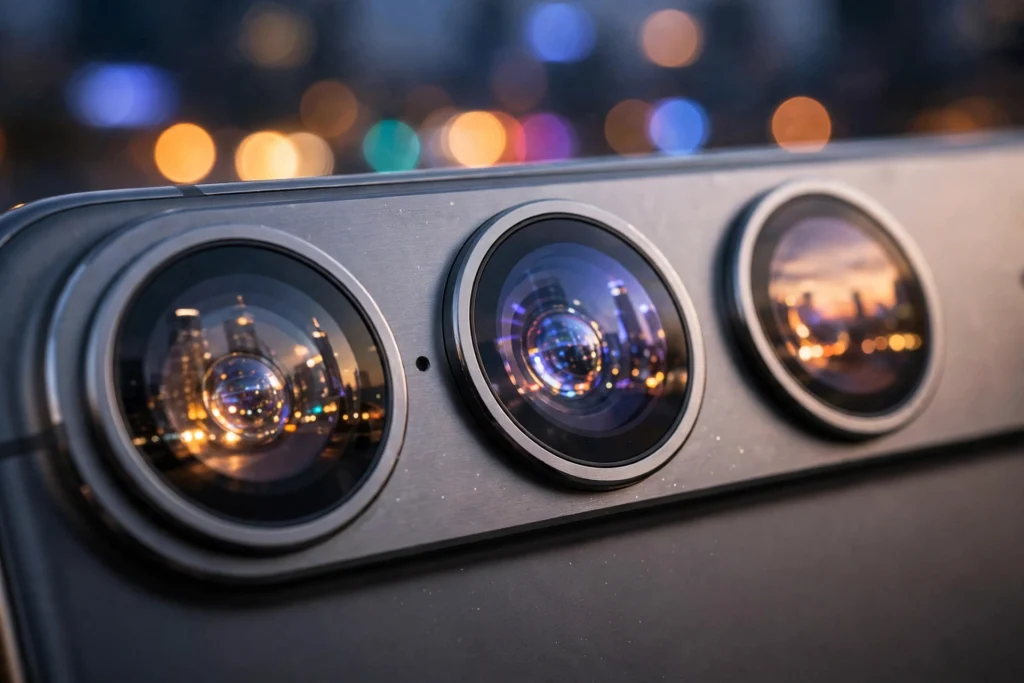
Google’s cameras work differently from most rivals. The sensors are good but not the biggest in the industry; the magic is that every frame gets processed, aligned and enhanced by the Tensor chip. The Pixel 10 Pro’s main camera is a 50-megapixel wide lens with an f/1.68 aperture and a 1/1.3-inch sensor — a generous size that drinks in light and anchors every shot.
It is flanked by two more 48-megapixel shooters: an ultrawide with macro focus for close-up work, and a 5x telephoto for reach. Google claims optical-quality framing at 0.5x, 1x, 2x, 5x and 10x, with the Pro Zoom system extending all the way to 100x. That headline 100x number leans heavily on AI zoom rather than pure optics, but in practice the 5x telephoto keeps mid-range zoom crisp without digital tricks.
The Pixel 10 Pro XL carries the exact same camera system. The Pixel 10 Pro Fold trims slightly for its folding body — a 48-megapixel main camera, a 10.5-megapixel ultrawide and a 10.8-megapixel 5x telephoto — still a strong triple setup, just tuned for a thinner chassis.
Display: LTPO OLED With a 1–120Hz Sweep
The Pixel 10 Pro’s 6.3-inch screen is an LTPO OLED running at 1280×2856 resolution. LTPO matters because the refresh rate can sweep all the way from 1Hz when you are reading a static page up to 120Hz when you are scrolling or gaming. That wide range saves real battery over the day compared with panels that can only drop to 60Hz.
The Pro XL stretches the same technology to 6.8 inches at 1344×2992, while the Pro Fold uses a 6.4-inch OLED panel that adapts between 60 and 120Hz — a narrower range, but still smooth for a foldable cover screen.
Supporting numbers round out the picture: the Pro packs 16GB of RAM and a 4,870mAh battery with fast wired charging plus Qi2 magnetic wireless charging through Pixelsnap accessories. The XL steps up to 5,200mAh and 45W wired charging, and the Fold carries 5,015mAh.
Current Flagships
The Google Pixel 10 Pro is the balanced pick — the full camera system and Tensor G5 in a comfortable size. Step up to the Google Pixel 10 Pro XL if you want the bigger screen and battery, or explore the folding option on the Google brand page to compare the whole lineup.
FAQ
Does the Pixel 10 Pro use a Snapdragon chip?
No. The Pixel 10 Pro runs Google’s own Tensor G5 with a Titan M2 security chip. Google designs Tensor for AI and camera workloads rather than raw gaming benchmarks, which is why Pixel phones feel smart rather than simply fast.
How good is the Pixel 10 Pro camera zoom?
The 48-megapixel 5x telephoto gives true optical zoom at five times, and Google claims optical-quality results at 10x through processing. The 100x Pro Zoom setting exists but relies on AI enhancement rather than real optics.
What is special about the Pixel’s LTPO display?
The LTPO panel on the Pixel 10 Pro can drop its refresh rate to 1Hz for still content and ramp to 120Hz when you scroll. That flexibility stretches battery life in a way fixed-refresh screens cannot match.
Sources: Google Pixel 10 Pro · Google Pixel 10 Pro XL · Google brand page